
Kategorien
Neuester Blog
What Trolley Features Improve Assembly Line Efficiency?
Nov 23 , 2026The trolley features that improve assembly line efficiency most are the right load capacity, smooth-rolling casters, practical shelf layouts, durable materials, easy maneuverability, and a design that matches the workstation. A well-selected industrial trolley helps operators move components, tools, and finished parts with fewer interruptions. It can also reduce unnecessary walking, keep materials organized, and make line-side replenishment more predictable.
For manufacturers, the best trolley is not simply the one with the largest platform or highest load rating. It should fit the production route, aisle width, component size, and frequency of material transfers. Guangzhou YLcaster Metal Co., Ltd. (YLcaster) offers platform trolleys, multi-layer trolleys, and steel mesh trolley solutions that can be evaluated for different factory material-handling tasks.
Explore the YLcaster trolley product range to compare trolley structures and load capacity options for industrial production and internal logistics.
Start by looking at how materials move through the assembly line. Do workers collect components from a central warehouse? Are small parts delivered to each workstation several times per shift? Do operators need to move tools, fixtures, or finished products between production areas?
These questions determine the trolley design. A flat platform trolley is useful for boxes, larger components, and packaged materials. A multi-layer trolley gives workers separate levels for different parts or production orders. A mesh-sided trolley can help contain loose components and tools during movement.
It is also worth measuring the route before ordering. Check aisle width, turning areas, workstation entrances, floor joints, and any ramps. A trolley that is too wide may block other workers or make it difficult to approach a workstation. A suitable design should move easily while keeping the production route clear.
Load capacity is one of the first specifications to confirm. Estimate the heaviest load that will be carried during normal production, including components, bins, packaging, and tools. Avoid selecting a trolley based only on average load if larger batches are common during busy shifts.
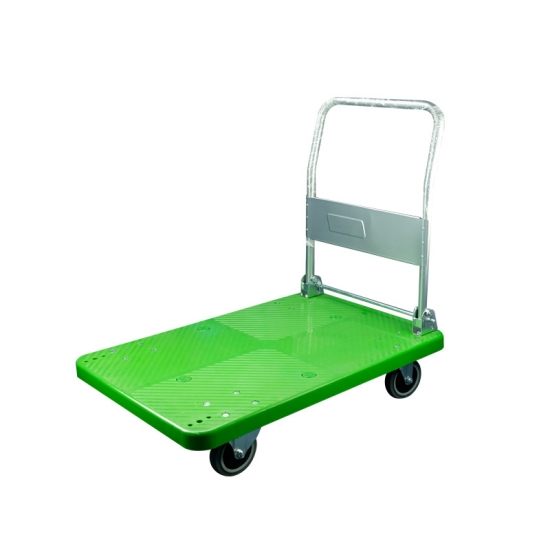
YLcaster's High Quality Plastic Foldable Hand Trolley, model W019XXXPP, is listed with 150 kg, 300 kg, and 500 kg capacity options. Its published construction is PP + steel, and the wheel arrangement is two rigid casters and two swivel casters. This gives buyers several configurations to consider for different internal transport tasks.
Platform dimensions are just as important as capacity. Measure the largest box or component container that needs to fit on the trolley. The load should sit securely on the platform without excessive overhang. If workers need to carry several types of components together, consider whether separate shelves or removable containers would make handling easier.
See the YLcaster W019XXXPP plastic foldable hand trolley for its published load options and construction details.
In assembly operations, workers often need several components at the same time. A multi-layer trolley can keep different parts separate and make frequently used items easier to reach. This is particularly useful when a workstation handles multiple product versions or when materials must be delivered in a specific sequence.
YLcaster's three-layer plastic platform trolley, model W019XXXHPP-3, is listed with 150 kg and 300 kg load capacity options. The product page specifies blue color and PP + steel construction. It also describes a three-layer design, four wheels, and a silent-running feature.
For production teams, the practical advantage is the extra sorting space. For example, one shelf can hold small components, another can carry tools or work-in-process items, and the lower shelf can be used for heavier containers. The exact arrangement should follow the workstation's process and safe loading practice.
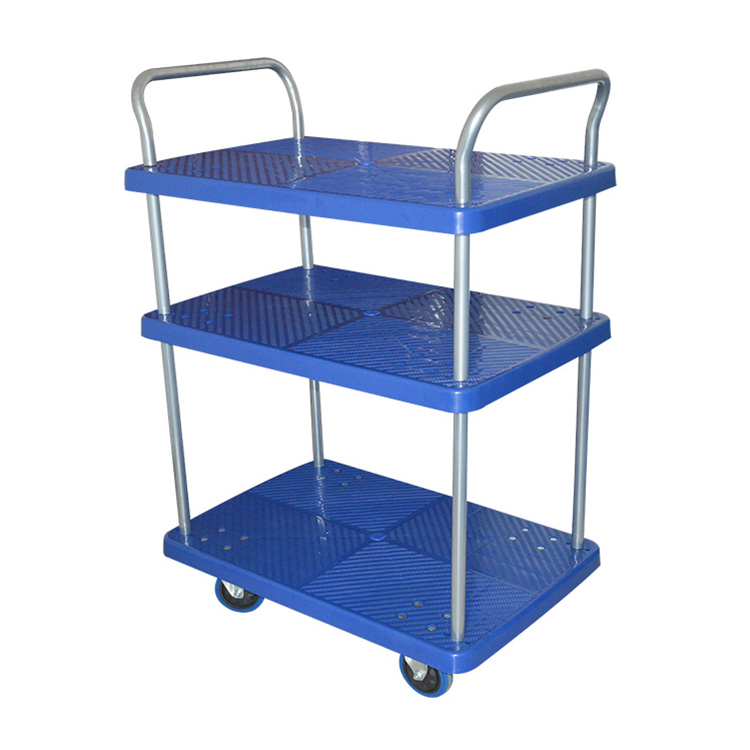
Review the YLcaster W019XXXHPP-3 three-layer platform trolley when separate loading levels are important for your production process.
Casters have a direct effect on how easily a trolley starts, turns, and travels across a factory floor. If wheels create too much rolling resistance or make the trolley difficult to steer, operators may need more effort to move materials between workstations.
YLcaster lists a two-rigid and two-swivel caster arrangement on the W019XXXPP and W019XXXMC trolley models. Rigid casters help the trolley travel in a straight direction, while swivel casters support turning. This combination is worth considering for production routes that include both straight aisles and frequent workstation turns.
Wheel material should match the floor. For indoor production areas where noise matters, YLcaster has also published a silent platform trolley specification using 125 × 32 mm TPR wheels. The listed caster load capacity is 120 kg, while the trolley itself is stated to carry 300 kg. These figures describe different components and should not be confused: the caster rating is not the complete trolley payload.
The table below summarizes specifications published by YLcaster. It can help purchasing teams shortlist trolley types for different assembly line applications. Always confirm the exact configuration and dimensions with the supplier before ordering.
| Product / Model | Published capacity | Material / structure | Wheel information | Potential production use |
|---|---|---|---|---|
|
W019XXXPP Plastic Foldable Hand Trolley |
150 / 300 / 500 kg | PP + steel | 2 rigid + 2 swivel | General material and component transport |
|
W019XXXHPP-3 Three-Layer Platform Trolley |
150 / 300 kg | PP + steel; 3 layers | 4 wheels | Small parts and separated component groups |
|
W019XXXMC Steel Mesh Tool Trolley |
300 kg | Steel / iron mesh structure | 2 rigid + 2 swivel | Tools, loose parts, and grouped materials |
For a trolley with side containment, the W019XXXMC is another option to assess. YLcaster lists a 300 kg load capacity, steel / iron construction, and two rigid plus two swivel casters. Its mesh structure can be useful when the load includes tools or loose items that should not slide off an open platform.
View the YLcaster W019XXXMC 300 kg steel mesh tool trolley for its published product details.
Assembly line trolleys may be used repeatedly throughout a shift. Platform material, frame construction, handle strength, and caster quality all affect service life. PP + steel construction is one option in YLcaster's range, combining a plastic platform with a steel structure. Steel mesh designs are available for applications that need side containment.
Think about the working environment before choosing a material. Will the trolley carry metal parts with sharp edges? Does it need frequent cleaning? Is it used near oil, moisture, or chemicals? If the environment is demanding, ask the supplier about the exact material grade, surface treatment, and maintenance requirements.
A good trolley works best when it is part of a clear material delivery process. Assign specific trolley routes, set a regular replenishment schedule, and identify where each trolley should be parked. This helps prevent carts from blocking walkways or being left in the wrong production area.
Use labeled bins or shelf positions to separate components by workstation or production order. Keep heavier items on lower shelves and frequently used items within easy reach. Avoid overloading the trolley or stacking goods so high that the operator's view is blocked.
Regular checks also matter. Inspect caster movement, wheel wear, handle fasteners, platform condition, and any brakes or locking features. A damaged wheel can make a trolley harder to control and interrupt material delivery when the line is busy.
Before requesting a quotation from Guangzhou YLcaster Metal Co., Ltd., prepare the maximum load per trip, largest component dimensions, platform size, number of shelves, aisle width, floor type, and daily operating frequency. Also confirm whether the trolley needs silent wheels, a folding handle, mesh sides, special colors, or customized dimensions.
Ask for a drawing or specification sheet that shows the complete trolley dimensions, platform dimensions, caster details, and rated payload. For bulk purchases, testing a sample on the actual production floor can help confirm maneuverability and loading convenience before placing a larger order.
YLcaster's trolley range covers different platform and multi-layer designs for material handling. By matching the trolley configuration to the production route, manufacturers can make internal transport more organized and reduce avoidable handling interruptions.
What trolley features improve assembly line efficiency?
The most useful features include suitable load capacity, smooth-rolling casters, practical shelf layouts, durable materials, easy steering, and dimensions that fit the production route. These features help workers move components and tools with fewer interruptions.
Is a multi-layer trolley suitable for assembly line material handling?
Yes. A multi-layer trolley can separate components, tools, and work-in-process items by shelf. YLcaster's W019XXXHPP-3 is a three-layer platform trolley listed with 150 kg and 300 kg capacity options.
What load capacity should an assembly line trolley have?
Choose a capacity based on the heaviest expected load per trip, including containers and packaging. YLcaster's W019XXXPP is listed in 150 kg, 300 kg, and 500 kg options. Confirm the exact version before purchasing.
Why are two rigid and two swivel casters useful?
Rigid casters help a trolley travel straight, while swivel casters make turning easier. This combination can suit factory routes that include straight aisles and frequent changes in direction.
Are TPR wheels suitable for indoor factory trolleys?
TPR wheels can be considered when quieter movement is important. YLcaster has published a silent trolley specification with 125 × 32 mm TPR wheels. Confirm the wheel rating and suitability for the actual floor and trolley load.
Can YLcaster provide trolley solutions for different production needs?
Guangzhou YLcaster Metal Co., Ltd. offers platform and multi-layer trolley products and states that customization is available. Buyers should provide dimensions, load requirements, materials, caster preferences, and application details for evaluation.