


Kategorien
Neuester Blog
What Specifications Should You Check Before Integrating Nylon Caster Wheels Into Industrial Trolleys?
Oct 19 , 2026Check these specifications before you integrate nylon caster wheels into industrial trolleys: material grade, load capacity, wheel diameter and width, bearings, mounting type, braking options, swivel versus fixed configuration, application match, build quality, spare parts, noise and vibration, floor protection, maintenance and hygiene, customization, and cost-quality balance. Verifying these specs prevents premature wear, trolley failure, and workplace accidents. Nylon wheels suit many industrial trolley applications, but only when the specifications match your actual load and floor conditions.
You can also request Customizable Caster Single Wheels from suppliers to match specific trolley frames and duty cycles.
| Specification | What to Check | Key Guidance for Nylon Caster Wheels |
|---|---|---|
| Load Capacity | Calculate total weight (trolley + load + dynamic stress) and apply a safety factor | Use (total weight ÷ number of wheels) × 1.3–1.5 to account for uneven load distribution during turning and ramps |
| Wheel Diameter & Width | Match size to floor obstacles and load spread | Larger diameter rolls easier over gaps and joints; wider wheels reduce floor pressure; 125–200 mm common for heavy-duty use |
| Wheel Material | Balance durability, noise, and floor protection | Nylon is tough and chemical-resistant but noisy and may mark floors under heavy loads; PU is quieter and more floor-friendly |
| Bearing Type | Determines rolling smoothness and service life | Plain bush for light use, roller bearing for strong loads, ball bearing for smooth rolling, sealed bearings for dusty daily use |
| Swivel vs Rigid | Choose based on aisle layout and control needs | 2 rigid + 2 swivel for straight-line control in long aisles; 4 swivel for tight turning in compact spaces |
| Mounting Type | Ensure mounting matches frame and side forces | Top plate mount is stronger and more stable for heavy-duty use; bolt hole or stem mount is easier but frame-dependent |
| Brakes & Locks | Safety during loading, sorting, and slopes | Wheel brake, total lock (wheel + swivel), directional lock for long aisles |
| Floor Conditions | Reduce rolling resistance and marking | Non-marking PU or quality rubber on smooth epoxy; softer tread on rough concrete to cut vibration and noise |
Load and dimension specifications form the foundation of every safe nylon caster wheel integration. You cannot correct a wrong load rating or a wrong wheel size after the trolley enters service. You can only replace the wheels, and that replacement costs far more than a careful review before purchase. This section walks you through the four specification groups that determine whether your nylon wheels survive daily industrial duty or fail within months.
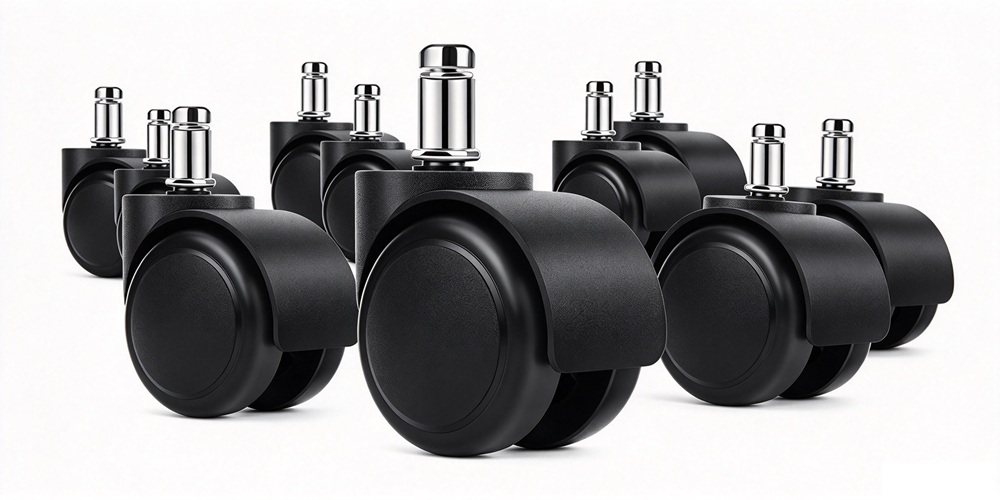
When selecting Nylon Single Wheel Heavy Duty Trolley Wheels, it is important to know that nylon is not a single material. Industrial casters use several grades of polyamide, each delivering different mechanical properties. Standard nylon 6 offers good toughness and moderate impact resistance. Nylon 66 provides higher stiffness and better heat resistance. Glass-filled nylon grades add fiber reinforcement, which raises load capacity and reduces deflection under sustained weight. Always confirm the exact grade with your supplier to match your operating temperature, chemical exposure, and load profile.
Wheel material affects practical usable capacity in service, not just floor compatibility. Soft materials like polyurethane deform under sustained heavy loads, increasing rolling resistance and reducing effective capacity over time. Hard materials like nylon maintain their shape better under load but offer less floor protection and can be noisier. For high-load applications, choose a wheel material rated for the full operating load under your temperature and chemical conditions. A nylon grade that performs well at room temperature may soften or become brittle in a freezer aisle or near a heat-treatment line.
Composition also influences chemical resistance. Nylon resists many oils, greases, and mild solvents. Strong acids and certain chlorinated compounds attack it. You should list every chemical the trolley will contact, including cleaning agents, and verify the grade against that list. Suppliers who offer customizable caster single wheels can often adjust the compound or add stabilizers for specific environments.
Load capacity is the specification most often miscalculated, and the consequences are the most severe. You must start with the total supported weight: the trolley, the payload, and any attachments. Then you divide by the effective caster count and apply a safety factor. The formula below is the standard starting point for this calculation.
Required capacity per caster = (Total supported weight ÷ Effective caster count) × Safety factor
Where effective caster count = 3 on uneven or real-world industrial floors, or 4 only on a verified-flat surface.
The safety factor depends on how you move the trolley and what surface it crosses. The table below gives the recommended ranges for common application types.
| Application Type | Recommended Safety Factor |
|---|---|
| Manual push, smooth indoor floor | 1.5 |
| Frequent movement, mixed surfaces | 1.5 – 2.0 |
| Towing, rough floors, thresholds | 2.0 – 2.5 |
| Motorized or safety-critical use | 2.5 – 3.0+ |
RS Components' caster selection guidance recommends that total caster capacity be at least 30% higher than the fully loaded weight of the equipment. That 30% margin is the minimum buffer needed to absorb the load variation that divide-by-4 ignores. A 30% margin corresponds roughly to a 1.5 safety factor, which suits light manual use on smooth floors. Heavier duty demands more.
Impact forces explain why the higher ranges exist. Thresholds, expansion joints, rough concrete, ramps, and powered towing create impact forces exceeding static load. A cart pushed over a door threshold experiences a momentary spike of 1.5 to 2 times the rolling load. For such applications, the safety factor should be at the higher end of the range for the movement type, or above it. You should inspect your actual travel path and note every threshold, joint, and ramp before you finalize the rating.
For context on how seriously industry treats safety factors, OSHA 29 CFR 1926.451(a)(1) requires each scaffold and scaffold component to support at least 4 times the maximum intended load (a 4:1 factor per component). This is the most demanding safety factor in common industrial use and applies specifically to personnel-supporting structures in construction. For most industrial cart and equipment applications, the required safety factor is lower, typically 1.5 to 2.0 depending on application severity. Nylon wheels on a warehouse trolley do not need scaffold-level margins, but they do need an honest assessment of dynamic loads.
Wheel diameter and width control rolling effort, obstacle clearance, and load distribution. The two dimensions work together, and you should select them as a pair rather than independently. The table below summarizes how each dimension affects performance.
According to a material handling solutions guide, trolley wheel diameter typically ranges from 75 mm to 300 mm, depending on the duty rating. The guide notes that larger wheels roll more easily over rough surfaces, while wider wheels distribute the load to protect sensitive floors. However, no specific standard width values (in mm) are given. You should therefore treat diameter as the primary selection variable and match width to the load and floor conditions you actually face.
The table below maps common diameter ranges to typical applications. Use it as a starting point, then confirm against your load calculation.
A larger wheel also changes the mounting height of the trolley deck. You should verify that a diameter increase still fits the frame, the fork clearance, and any dock or conveyor interface. Width increases can interfere with fork spacing and swivel clearance. Measure the available envelope before you commit to a size.
Floor protection and rollover behavior determine how the wheel interacts with the surface beneath it. On rigid surfaces, a hard wheel such as nylon yields low rolling resistance because deformation is minimal. On deformable surfaces (turf, packed dirt), the wheel sinks until contact area supports the load, creating a rut the wheel must continually climb out of. Engineering analysis confirms that increasing wheel diameter reduces rolling resistance on rough terrain: a larger wheel has a shallower approach angle to obstacles, letting it roll over rocks or cracks instead of being halted. The geometric relationship between wheel radius (r) and obstacle height (h) governs the force vector needed to surmount the impediment—as h approaches r, the required horizontal force approaches infinity, causing blockage.
That relationship has a practical meaning for your trolley design. A 100 mm nylon wheel facing a 20 mm expansion joint has an obstacle-to-radius ratio of 0.4, which demands a significant push force. A 200 mm wheel facing the same joint has a ratio of 0.2, and the push force drops sharply. If your operators complain about catching at joints, the fix is usually a larger diameter, not a harder push.
Floor protection is the trade-off you accept with nylon. Nylon is hard, and hard wheels concentrate load on a small contact patch. On epoxy coatings, tile, and sealed concrete, a loaded nylon wheel can leave marks or wear paths over time. Wider wheels spread the load and reduce point pressure. You should match wheel width to floor sensitivity and consider non-marking alternatives only where floor appearance matters more than durability. For most industrial environments, nylon remains the practical choice, provided you verify the floor rating and the wheel width together.
Mechanical and mounting specifications determine how the nylon caster wheel attaches to your trolley, how it moves, and how long it lasts. A wheel with the right load rating can still fail early if the bearing is undersized, the mounting plate does not fit the frame, or the swivel configuration fights your aisle layout. You should treat each of the five specification groups below as a gate. A mismatch in any one of them will show up as premature wear, poor steering, or a safety hazard.
The bearing sits at the heart of every caster wheel. It carries the load, reduces friction, and controls how smoothly the wheel rolls. Bearing type affects both performance and lifespan, and the right choice depends on your load, your floor, and how often the trolley moves.
Plain bearings suit light loads and low duty cycles. They cost less and tolerate dirty environments. Roller bearings carry heavy loads and resist shock. Precision ball bearings deliver smooth rolling and easy steering. Sealed bearings keep dust and moisture out, which matters in warehouses, food plants, and outdoor yards.
Available bearing types include plain, ball, and Delrin bearings, supporting reliable operation over wide temperature ranges. Their durability, floor protection, and assistance in noise reduction make them ideal for diverse mobile applications across healthcare, retail, and facility maintenance industries.
You should match the bearing to your duty cycle. A trolley that moves once per shift needs less bearing quality than one that runs all day. Ask your supplier for the bearing type, the seal class, and the rated load. A quality bearing costs more upfront and returns that cost through longer service life and fewer replacements.
Mounting type and plate fit decide whether the caster bolts cleanly to your trolley frame. A top plate mount is the most common choice for industrial trolleys. It spreads load across a flat plate and resists side forces well. Bolt hole and stem mounts suit lighter frames and specific frame designs. You should confirm the plate dimensions, the bolt hole pattern, and the bolt size before you order.
A standard caster plate measures 4 in. x 4-1/2 in. with a B bolt hole pattern. The inside bolt hole spacing is 3 in. x 3 in., and the plate uses four mounting holes. You should measure your frame against these values, not assume them.
Plate fit also affects load transfer. A plate that is too small concentrates stress on the frame and can crack the mounting surface. A plate that is too large may not fit the frame envelope or may interfere with swivel clearance. You should check the fork clearance and the swivel radius as well. The wheel must rotate freely without striking the frame, the brake pedal, or nearby components.
Swivel and fixed casters serve different purposes, and the right mix depends on your aisle layout and load. A swivel caster rotates 360 degrees and lets the trolley turn in any direction. A fixed caster locks to straight-line travel and provides stability and higher load capacity. You should choose the configuration before you finalize the frame design, because the layout affects steering effort and tracking.
| Feature | Swivel Configuration | Fixed (Rigid) Configuration |
|---|---|---|
| Rotation | 360° full rotation for maneuverability | Locked to straight-line movement only |
| Best for | Tight spaces, frequent turns | Long straight paths, heavy loads |
| Steering effort | Higher, wheel must rotate | Lower, push straight with less force |
| Tracking stability | Can wander if all swivel | Excellent, stays on course |
| Load capacity (same wheel size) | Slightly lower due to bearing complexity | Slightly higher due to simpler construction |
| Brake option | Wheel lock or total lock | Wheel lock only |
Swivel casters give you maneuverability in any direction, reduced effort to steer around obstacles, and versatility across many applications. Fixed casters give you greater stability in straight lines, higher load capacity from even weight distribution, and greater durability from fewer moving parts. A combined setup with two swivel at the front and two fixed at the rear balances maneuverability with stability and control. Nylon wheels are a high-load-capacity material with poor floor protection, and suppliers offer them in both swivel and fixed designs. The configuration differences above apply to nylon casters as well. You should confirm the swivel radius and the offset before you commit, because a long offset increases steering ease and reduces the load the caster can carry.
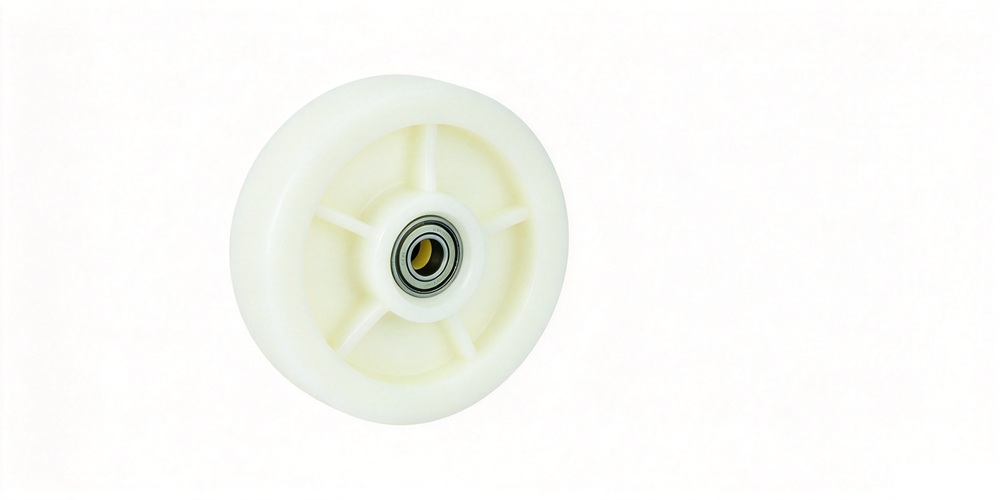
For 5-Pack 2" White Nylon Stem Casters, braking and locking options protect workers during loading, sorting, and parking on slopes. A wheel brake stops the wheel from rolling. A total lock brake stops both the wheel and the swivel action. A directional lock keeps the swivel fixed in a straight line for long aisles. You should match the brake type to the task, not add the most expensive option by default.
A nylon brake option is corrosion-resistant and can lock both the wheel and the swivel at the same time. That combination suits medium-size load applications well.
Total locking brakes perform best with softer wheel materials (neoprene, soft rubber, thermoplastic rubber, polyurethane) because the brake pad grips the tread more effectively. They can still be used with harder wheels such as nylon, but a strong push may cause slight movement of the caster wheel.
That note matters for nylon wheels. Nylon is hard, and a total lock brake grips it less firmly than it grips a soft tread. You should test the brake under your actual load and slope before you rely on it for safety. For critical holding tasks, add a floor lock or a chock as a backup.
Build quality decides whether your nylon caster wheels last years or months. You should inspect the wheel surface, the welds, the coating, and the overall construction before you accept a shipment. A poorly built wheel wears out quickly and poses a safety risk.
You should also look for a smooth finish on the wheel surface, solid welding at joints, robust overall construction, and uniform construction for consistent performance under load. Anti-corrosion coatings extend life in humid or wet conditions. A high-quality finish contributes to both appearance and durability. Spare parts availability protects your fleet over time. You should confirm that the supplier stocks replacement wheels, bearings, brake pads, and mounting hardware. A supplier who offers customizable caster single wheels can also supply matched spares for your specific frame and duty cycle. Ask for the part numbers and the lead times before you place a fleet order. A caster that fails with no spare on hand can idle a trolley for days.
You must match the caster to the real duty cycle, not the ideal one. A trolley that runs eight hours a day on concrete demands a stronger wheel than one that moves twice per shift. Count the daily travel distance, the number of turns, and the load variation. Nylon wheels handle high duty cycles well when the load rating stays within limits. A mismatch here shortens wheel life and raises replacement costs.
Nylon wheels transmit more noise and vibration than softer materials. You should test a sample on your actual floor before a full rollout. Vibration loosens fasteners and fatigues the frame over time. A larger wheel diameter and a quality bearing reduce both noise and vibration. Operators notice the difference quickly, and lower vibration protects the trolley structure.
You need a simple inspection routine. Check the wheel tread, the bearing play, and the brake function at set intervals. Nylon resists most cleaning agents, so washdown environments suit it well. Confirm the hygiene standard for your facility, especially in food or pharmaceutical areas. A wheel that traps debris creates a cleaning burden you cannot ignore.
Suppliers offer customizable caster single wheels for non-standard frames and special duty cycles. You can specify the plate pattern, the bearing type, and the brake configuration. Customizable caster single wheels also let you match the wheel width to a sensitive floor. Request drawings and samples before you approve a custom run.
The cheapest wheel rarely delivers the lowest total cost. You should weigh purchase price against service life, replacement labor, and downtime. A premium nylon wheel often pays back within the first year of heavy use. Compare total cost of ownership across the fleet, not unit price alone.
Check material, load, dimensions, bearings, mounting, braking, configuration, application fit, build quality, spare parts, noise, floor protection, maintenance, customization, and cost balance before you integrate nylon caster wheels. A specification mismatch found after installation costs far more than one caught before purchase. Request test data and samples from suppliers, including customizable caster single wheels, before you commit to a full trolley fleet upgrade.
A: Add the trolley weight and the payload weight. Divide by the effective wheel count. Multiply by a safety factor of 1.5 to 2.0 for dynamic loads.
A: Choose sealed ball bearings or roller bearings for dusty environments. Sealed bearings block debris and keep the wheel rolling smoothly through daily industrial use.
A: Yes, you can use nylon wheels on epoxy floors. Choose a wider wheel width to spread the load. Inspect the floor for wear paths during routine maintenance.