
Kategorien
Neuester Blog
Folding Hand Trolley vs. Platform Trolley: Which Is Better for Commercial Use?
Nov 16 , 2026When comparing a folding hand trolley vs. a platform trolley, buyers should look beyond the folding mechanism or initial purchase price. Load capacity, wheel configuration, platform size, maneuverability, and long-term durability all affect daily productivity. Guangzhou YLcaster Metal Co., Ltd. offers trolley solutions for warehouse handling, logistics, hotels, restaurants, and other commercial environments. This guide explains how to choose the right design for your operation.
A folding hand trolley generally has a compact frame, a handle, and a small loading plate. Many models fold down when not in use. The operator tilts the trolley backward and balances the load over its wheels. This design is convenient for moving individual cartons, parcels, small equipment, and supplies through narrow spaces or between delivery vehicles and customer locations.
A platform trolley has a horizontal deck supported by multiple wheels, usually with a handle for pushing. The load rests on the platform rather than being balanced against a small toe plate. This makes it more practical for moving several boxes, bulky packages, or heavier goods across warehouse floors. Depending on the model, the platform may be made from plastic, steel, or another material.
The key distinction is how the load is supported. A folding hand trolley prioritizes portability and compact storage; a platform trolley prioritizes a larger loading surface and stable movement for commercial material handling.
| Selection factor | Folding hand trolley | Platform trolley |
|---|---|---|
| Typical use | Individual cartons and light goods | Multiple packages and bulky loads |
| Storage | Compact when folded | Requires more floor space, depending on design |
| Load support | Small loading plate | Larger horizontal platform |
| Maneuverability | Useful in tight spaces and delivery routes | Useful for organized indoor transport |
| Best purchasing priority | Portability and storage | Capacity and platform dimensions |
These are general design differences rather than fixed performance limits. Actual capacity and dimensions vary by model, so buyers should always check the product specification before placing a bulk order.
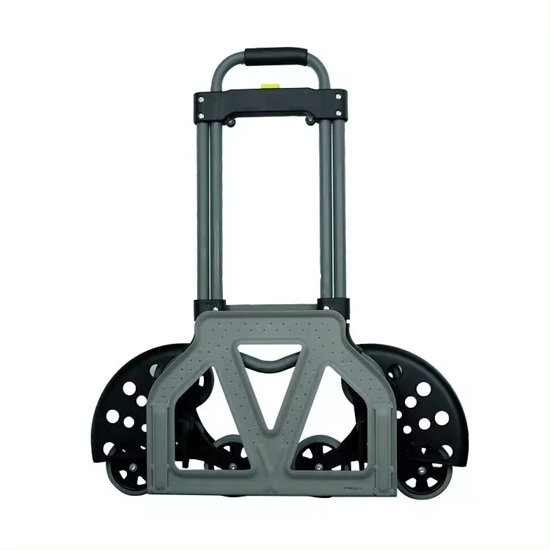
A folding hand trolley is a practical option when employees need a portable tool that can be stored in a vehicle, utility room, or small stock area. Retail replenishment, parcel delivery, office supply movement, maintenance work, and light-duty warehouse tasks are common examples.
Its compact structure can reduce storage demands, particularly for businesses that do not need a trolley at every workstation. A foldable model can also be useful for service teams that move equipment between different locations during the day.
For example, YL Caster lists the T004T004TPR foldable stair-climbing hand trolley with a stated load capacity of 30 kg and a two-wheel design. It is a compact option for lighter transport requirements. Its specified capacity also makes the selection boundary clear: it should not be treated as a substitute for a heavy-duty warehouse platform trolley.
For buyers comparing compact transport equipment, the YL Caster T004T004TPR foldable hand trolley provides a specific model reference for evaluating lightweight handling needs.
For regular warehouse operations, a platform trolley is often the more versatile choice. Employees can load several cartons or larger items onto one deck and move them together. This can reduce repeated trips between storage racks, packing stations, dispatch areas, and loading bays.
Platform dimensions are particularly important. A trolley that is too small may require goods to be stacked unsafely or transported in multiple trips. A larger platform can accommodate more items, but it must still fit through aisles, doorways, lifts, and loading areas. Buyers should measure the narrowest route before choosing a deck size.
YL Caster's W019XXXPP Plastic Folding Platform Hand Trolley is listed with load capacity options of 150 kg, 300 kg, and 500 kg. The product uses a PP and steel construction and offers a wheel configuration of two rigid and two swivel casters. The manufacturer also describes a low-noise caster design. These features make it a relevant option for commercial environments such as warehouses, hotels, restaurants, and food-service operations.
For a business that needs a larger loading surface and a choice of capacity levels, review the W019XXXPP plastic folding platform hand trolley specifications before comparing models.

The product page specifies 150 kg, 300 kg, and 500 kg capacity options. These are model options, not a statement that every trolley carries all three loads. Confirm the selected configuration, dimensions, and rated capacity in the quotation and order documents.
Load capacity: Calculate the maximum weight of the goods moved in one trip, including packaging. Choose a trolley with a rated capacity that safely covers the intended load. Do not assume that a larger-looking frame automatically has a higher rating.
Wheel arrangement: A common platform trolley configuration is two rigid casters and two swivel casters. Rigid wheels help maintain a straight direction, while swivel wheels support turning. Consider aisle width, turning frequency, floor joints, ramps, and thresholds when evaluating wheel suitability.
Platform material: PP and steel combinations are used in commercial platform trolley designs. The right material depends on load type, cleaning requirements, impact exposure, and operating environment. If the trolley will be used in a wet or corrosive area, ask the supplier about suitable materials and surface treatment.
Noise and floor protection: Noise can matter in hotels, restaurants, hospitals, and workplaces operating near offices or customers. Ask about wheel material and running noise, and test the trolley on the actual floor surface if quiet operation is important.
Storage and handling: A folding design may save space, but check how easily the handle or platform folds and unfolds. For platform models, confirm the overall dimensions and folded dimensions where applicable. Also consider whether staff can safely load, push, turn, and park the trolley.
The lowest purchase price does not always mean the lowest operating cost. A trolley that is too small for the daily workload may increase the number of trips. An unsuitable wheel configuration can make movement harder and increase wear. A model that cannot be stored conveniently may also take up valuable warehouse space.
For procurement teams, compare the total cost of ownership rather than the unit price alone. Consider purchase cost, expected service life, wheel replacement, maintenance, storage, and labor time. If a platform trolley allows employees to move more goods per trip, the productivity benefit may justify a higher initial cost. If the trolley is used only occasionally or transported between sites, a compact folding hand trolley may be more economical.
YL Caster offers a wider range of commercial hand trolleys and platform trolley solutions, allowing buyers to compare different designs and capacity options for their operating requirements.
Choose a folding hand trolley if your priority is portability, compact storage, and moving individual lighter items. Choose a platform trolley if your employees regularly transport multiple packages, bulky goods, or heavier loads across a warehouse or commercial facility.
For mixed operations, using both types can be more effective than expecting one trolley to handle every task. A compact hand trolley can support deliveries and small-item movement, while a platform trolley can handle routine stock transfers and warehouse replenishment.
Before requesting a quotation from Guangzhou YLcaster Metal Co., Ltd., prepare the required load capacity, product dimensions, quantity, wheel preference, working environment, and any customization requirements. Clear information helps the supplier recommend a suitable trolley configuration and confirm the specifications for your order.
Is a folding hand trolley or platform trolley better for warehouse use?
A platform trolley is generally better for routine warehouse transport involving multiple cartons, bulky goods, or heavier loads. A folding hand trolley is more suitable for lighter items, delivery work, and locations where storage space is limited.
What is the difference between a hand trolley and a platform trolley?
A typical folding hand trolley uses a small loading plate and a two-wheel design. A platform trolley has a larger horizontal deck and commonly uses four casters, making it suitable for moving several items together.
What load capacities are available from YL Caster platform trolleys?
YL Caster lists the W019XXXPP Plastic Folding Platform Hand Trolley in 150 kg, 300 kg, and 500 kg capacity options. Confirm the exact selected model and configuration before ordering.
What is the load capacity of the YL Caster T004T004TPR hand trolley?
The manufacturer's product page lists the T004T004TPR foldable stair-climbing hand trolley with a 30 kg load capacity and two wheels. It is intended for lighter transport tasks rather than heavy warehouse loads.
Are platform trolleys suitable for hotels and restaurants?
Yes. Platform trolleys can be used to move supplies, packaged goods, and equipment in hotels and restaurants. Buyers should consider wheel noise, platform material, load capacity, and the space available for turning and storage.
What should I provide when requesting a commercial trolley quotation?
Provide the required load capacity, load dimensions, trolley quantity, preferred platform material, wheel configuration, operating environment, and any folding or customization requirements. These details help the manufacturer assess the most suitable model.
Can YL Caster provide customized trolley solutions?
YL Caster states that it provides customized product services through its R&D team. Share your application details and technical requirements with the company to discuss whether a suitable customization is available.