


Kategorien
Neuester Blog
What Specifications Should You Check Before Integrating Foldable Heavy-Duty Hand Trolleys Into Warehouse Logistics?
Oct 12 , 2026You must verify the maximum load capacity of heavy-duty hand trolleys before any other specification. Choose a capacity at least 20–25% higher than your heaviest regular load. Weight distribution matters equally—a 1,000-lb trolley can still tip if the center of gravity sits too high. Getting this spec right prevents floor damage, worker injury, and early equipment failure.
You already know the rated load capacity matters most. Now you need to understand how that number gets verified and what happens when weight shifts during real warehouse operations.
Manufacturers test load capacity through several rigorous methods. These trials follow established industry standards that give you a reliable baseline for comparison. These standards matter because they simulate conditions your trolley will face daily. The testing protocols include:
| Standard | Scope / Testing Focus |
|---|---|
| ISO 22883 | Requirements for application casters running up to standard walking speeds; measures dynamic roll durability, impact energy absorption, and structural load distribution across wheel assemblies. |
| ISO 22884 | Performance parameters for heavy industrial wheel setups. |
| EN 12532 | European protocols for light-industrial hardware; tests static compression forces, swivel head play, and rotational movement resistance under peak payload conditions. |
| ANSI/MHIA B88.1 |
Referenced as an industry standard aligned with rigorous load capacity testing trials. |
| GS Mark (Tested Safety) |
Independent safety testing under German product safety laws; verifies handle latch safety, pinch-point hazards, and frame structural load limits. |
These trials align with ISO 22883, EN 12532, and ANSI/MHIA B88.1 standards. A trolley that passes these tests carries a verified load rating you can trust.
Weight distribution affects performance as much as total capacity. An uneven load makes any trolley unstable and hard to steer. You should place heavier items at the bottom and lighter items on top. Straps secure the load so it does not shift during transport. If the trolley feels difficult to push, redistribute the load evenly and check the wheels for wear. Cleaning and lubrication may also help.
According to a study by Johnson and Miller (2018), even load distribution among wheels significantly enhances stability and reduces wear on individual wheels. Their research demonstrated that four-wheel configurations offer a balance between stability and manoeuvrability for medium loads, while six or more wheels are preferable for heavy-duty applications to distribute weight more evenly and prevent tipping.
This research confirms what experienced warehouse operators know. More wheels spread the load better. A balanced load protects both your workers and your equipment.
The frame material determines how long your trolley lasts and how much weight it can handle safely. You have three main options: tubular steel, extruded aluminum, and stainless steel. Each material offers distinct advantages and trade-offs.
Tubular steel provides the highest tensile strength and strong resistance to blunt impacts. This material handles heavy industrial use well. However, steel is heavy and susceptible to rust in damp environments. You must maintain its coating carefully to prevent corrosion.
Extruded aluminum is rust-proof and weighs up to 30% less than comparable steel models. This weight reduction decreases operator fatigue during long shifts. Aluminum costs more upfront, but the ergonomic benefits often justify the investment.
Under extreme overload, aluminum bends gradually. Steel tends to snap suddenly at welded joints. These different failure modes affect safety and service life in important ways. A gradual bend gives you warning signs. A sudden snap creates immediate danger. Steel and stainless steel frames generally last longer under harsh usage conditions. Aluminum frames need less upkeep. Steel frames may require protective coatings or treatments to resist rust.
The strength-to-weight ratio deserves special attention when you compare materials. Aluminum offers distinct advantages in this area:
| Frame Material | Weight | Strength | Corrosion Resistance | Best Suited For |
|---|---|---|---|---|
| Aluminum | Light | Moderate | High | Light-to-medium loads, transport, outdoor use |
| Carbon Steel | Heavy | High | Moderate (prone to rust) |
Heavy industrial use, warehouse |
| Stainless Steel | Heavy | Very High | Excellent | Chemical, food industry, wet/humid environments |
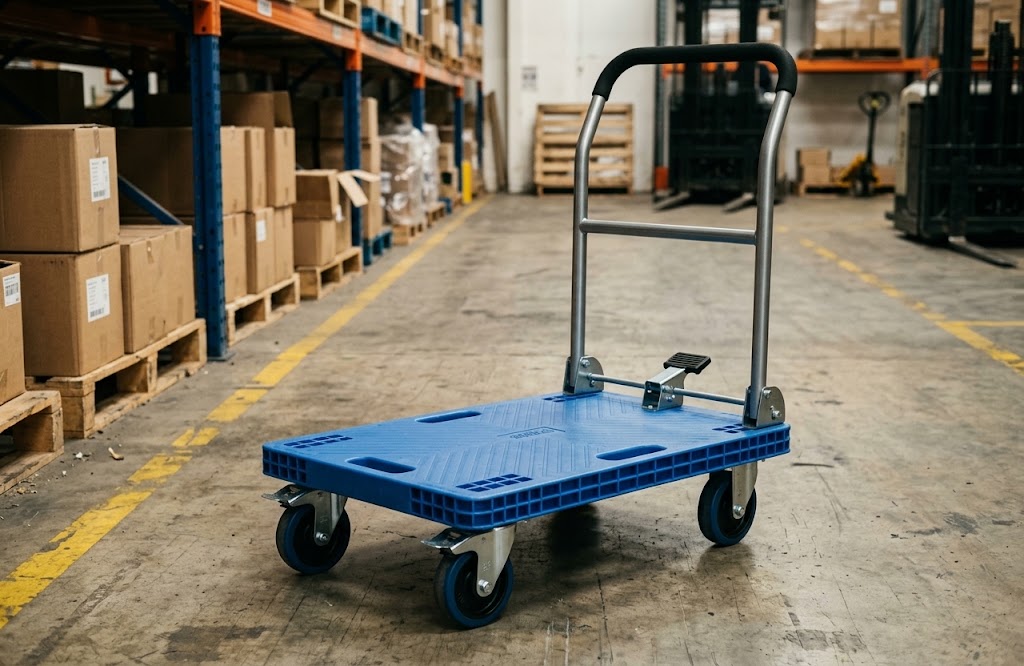
Aluminum framing's strength-to-weight ratio is higher than that of average stainless steel grades. Stainless steel offers superior overall strength, but it does so at the cost of increased weight. For structural aluminum alloys such as 6061-T6, the strength-to-weight ratio is often superior to steel in specific applications. Whether you are operating a standard hand truck rated for 200 kg or a multi-capacity 150KG 300KG 500KG Blue Square Tube Foldable Trolley series, an aluminum frame weighs 30–40% less than its steel equivalent. This weight reduction directly decreases the operator's cumulative workload. It serves as a quantifiable measure against repetitive strain injuries (RSI) over an eight-hour shift.
Corrosion destroys trolleys from the inside out. You must match the frame material and coating to your warehouse environment. A damp basement storage area demands different protection than a dry distribution center.
Stainless steel offers excellent corrosion resistance. This material works well in chemical plants, food processing facilities, and other wet or humid environments. The higher upfront cost pays off through extended service life and reduced maintenance.
Carbon steel requires protective coatings to resist rust. Powder coating and galvanized finishes create a barrier against moisture. You should inspect these coatings regularly for chips or scratches. Touch up any damage immediately to prevent rust from spreading.
Aluminum naturally resists corrosion without extensive coatings. This material suits outdoor use and humid conditions. Aluminum also cleans easily, which helps in facilities with strict hygiene requirements.
Wear resistance extends beyond the frame. You must examine wheels, bearings, and pivot points for signs of fatigue. Regular lubrication reduces friction and extends component life. A pre-shift inspection catches small problems before they become expensive repairs. The total cost of ownership depends on matching specifications to your actual conditions. A trolley that performs well in one environment may fail quickly in another. Consider your floor surfaces, humidity levels, and typical load weights before you commit to a bulk order.

Wheel material determines noise levels, floor protection, and load capacity. You must match the material to your warehouse environment and typical load weights.
| Wheel Material | Noise Level | Floor Protection | Durability / Load |
|---|---|---|---|
| Nylon (PA) | Very loud on hard surfaces | Poor — damages coated floors | Very hard, high load capacity |
| Rubber | Quiet initially | Good grip but prone to marks | Degrades quickly with chemicals |
| Polyurethane (PU) | Quiet | Non-marking, protects floors | High load capacity, resists abrasion |
| TPR | Low noise, smooth rolling | Protects floors | Combines resilience with strength |
Soft wheels absorb shock through slight compression under load. This reduces vibration and friction, which lowers noise and protects floors. Hard wheels transfer more shock directly to concrete. Over time, this breaks down the surface layer and causes subsurface cracking. Modern casters and wheels attached to dollies and carts make a larger contribution to overall noise levels than most operators realize. High-quality, shock-absorbing casters dampen both rolling noise and impact vibration.
Larger wheels reduce rolling resistance and handle uneven surfaces more easily. Small wheels struggle with cracks, cords, and floor seams. Larger wheels approach obstacles at a lower angle, so they roll over smoothly. This directly reduces the force you need to push heavy-duty hand trolleys over uneven warehouse floors.
Choose wheels with a diameter of 150mm or more for warehouses with cracks or debris. Smaller wheels increase pushing effort and cause operator fatigue. Match wheel hardness to your floor type. Soft wheels (Shore A 60–95A) protect tile, vinyl, and epoxy-coated concrete. Hard wheels (Shore D 70D+) suit smooth concrete and high-capacity loads but offer minimal floor protection.
The folding mechanism directly determines how much space you reclaim when the trolley is not in use. A well-designed mechanism collapses the frame into a flat, compact shape without compromising structural integrity. You need a mechanism that operates smoothly with minimal effort—ideally with one hand—so workers can fold and unfold the trolley quickly between tasks.
Aluminum frames dominate this category because they offer the best balance of portability and durability. An aluminum folding trolley weighs 30–40% less than a steel equivalent, making it easier to lift into a vehicle or carry to a different zone. The frame must also remain stiff and strong enough to handle daily warehouse abuse without bending at the hinge points.
Folding platform trolleys keep robust construction with high-strength materials such as aluminum or durable plastic, and their wheels are designed for easy maneuvering. However, the folding mechanism may reduce weight capacity, typically to around 300 to 500 pounds, so load requirements should be checked before choosing this type of trolley.
This trade-off matters. You trade some load capacity for storage flexibility. Measure your storage space before you select a model. A trolley that folds to a thickness of six inches fits between shelving units or inside a wall-mounted rack. A thicker fold may require floor space you cannot spare. The folded footprint must match your actual storage layout, not just a theoretical minimum.
Handle design influences every push, pull, and turn your operators make throughout an eight-hour shift. An ergonomic handle reduces strain on the back, shoulders, and wrists. A poorly designed handle amplifies fatigue and increases the risk of repetitive strain injuries.
Adjustable handle height is the most critical ergonomic feature. Operators come in different heights. A fixed handle forces taller workers to bend and shorter workers to reach upward. Both positions create muscle tension over time. A height-adjustable handle lets each worker set the grip at elbow height, keeping the forearms parallel to the floor and the wrists straight.
| Ergonomic Principle | Impact on Posture and Fatigue |
|---|---|
| Work surface height at or just below elbow height when standing | Maintains neutral posture, reduces bending and reaching |
| Elbows close to body, forearms parallel to floor, wrists straight | Prevents strain on back, shoulders, and wrists during scanning, typing, or labeling |
| Easy height adjustment for varying tasks | Allows workers to adapt setup throughout the day, reducing repetitive strain |
| Alternating between sitting, standing, and moving (20-8-2 rule) | Minimizes fatigue associated with staying in one position too long |
| Positioning equipment within easy reach | Reduces unnecessary movement and physical fatigue in high-volume environments |
Reaching, bending, and using equipment at the wrong height can lead to fatigue, discomfort, and mistakes. When workers can adjust their workstation to the right height, they can work more comfortably, move more easily, and stay productive throughout the shift. Over time, repetitive motions from fixed heights can contribute to worker fatigue, slower picking and packing speeds, increased risk of musculoskeletal strain, more scanning and labeling mistakes, and reduced employee satisfaction and retention.
Handle grip material also matters. Foam or rubber grips absorb vibration and provide a secure hold even with sweaty hands. Hard plastic grips transmit vibration directly into the operator's palms. For long shifts, choose a trolley with cushioned, contoured handles that match the natural curve of the hand. Small ergonomic details like these compound into significant productivity gains.
Safety features on foldable Heavy-Duty Hand Trolleys must meet or exceed ANSI standards for industrial equipment. You should verify each model against these requirements before you integrate it into your logistics workflow.
These five elements form a baseline for safe operation. Structural strength begins with the frame welds. Inspect each weld point for cracks, porosity, or incomplete fusion. A failed weld under load can cause a sudden collapse that injures the operator and damages goods. Manufacturers should provide weld inspection certificates from ISO-certified auditors.
Stability specifications matter just as much. The trolley must maintain balance during turns and on uneven surfaces. Wide wheelbases reduce tipping risk. Low center-of-gravity designs keep loads stable. Test the trolley with your heaviest typical load on a slight incline. If it feels tippy, the design fails your safety requirements.
Pre-shift inspections catch small problems before they become accidents. You need a simple checklist that operators can complete in under two minutes. Check the folding latch for full engagement. Examine the wheels for cracks or debris. Test the handle adjustment mechanism. Confirm that all fasteners remain tight. A brief inspection routine protects both your workers and your equipment investment.
Pro Tip: Use the six-point checklist as your purchasing filter. Cross-reference each specification against your actual warehouse conditions. Ergonomics-related injuries from mismatched equipment cost U.S. businesses over $13 billion annually. Build a side-by-side comparison of Heavy-Duty Hand Trolleys before your bulk order. Download our free Warehouse Trolley Spec-Check Worksheet to identify equipment gaps.
A: Check the manufacturer's test certification against ISO 22883 or ANSI/MHIA B88.1 standards. Demand documented proof of the safety factor, typically 1.3x to 1.5x above the working limit.
A: Match wheel hardness to your surface. Polyurethane protects epoxy and tile floors while carrying heavy loads. Nylon handles smooth concrete but damages coated surfaces. Soft rubber reduces noise but wears faster under chemicals.
A: Yes. Folding hinges typically lower capacity to around 300–500 pounds. Verify the folded rating against your heaviest regular load before you commit to a bulk order.